The 7 Rs of Cloud Migration: A Comprehensive Guide for Businesses
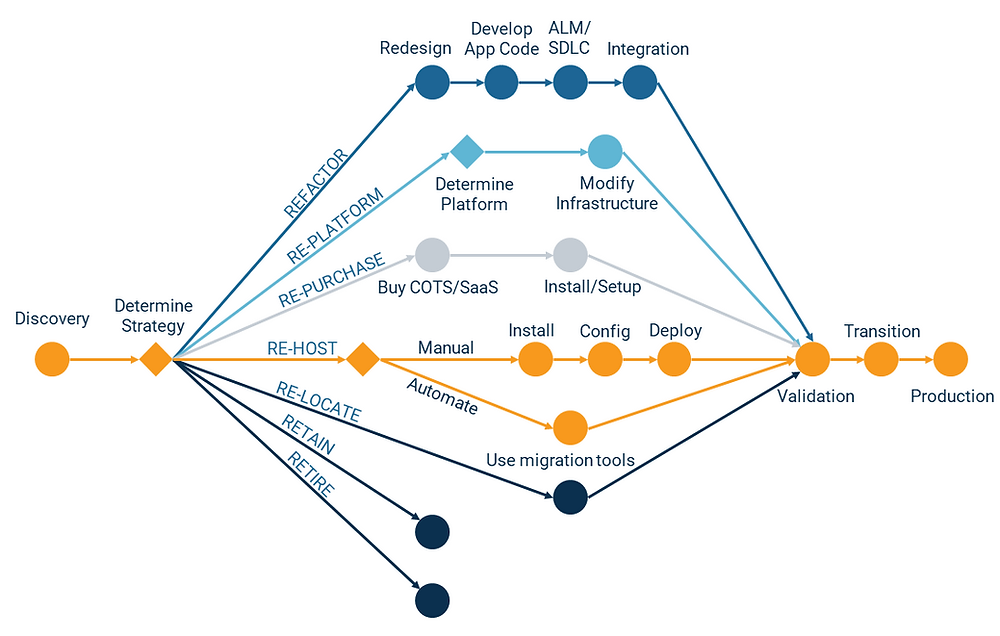
Cloud migration has become a cornerstone of modern IT strategy, enabling organizations to leverage the scalability, flexibility, and cost-efficiency of cloud computing. However, the journey from on-premises infrastructure to the cloud is complex and requires careful planning. To navigate this process effectively, businesses often turn to the “7 Rs” of cloud migration—a set of strategies that provide a structured approach to moving applications and data. These strategies, initially introduced by Gartner and later expanded by AWS, offer a roadmap for decision-making, ensuring that each workload is handled appropriately based on its unique requirements.
History of the Rs for Cloud Migration

The concept of the “Rs” in cloud migration originated with Gartner’s 5 Rs model, which was introduced during the early days of cloud computing. At the time, many organizations were struggling with the challenges of migrating legacy applications and data to the cloud. The 5 Rs provided a foundational framework for evaluating different migration approaches, helping businesses understand how to best transition their workloads.
Over time, as cloud computing evolved, so did the need for more comprehensive strategies. AWS recognized this gap and expanded the model to include a sixth R—Retire. This addition emphasized the importance of decommissioning or replacing outdated systems that no longer provided value. Eventually, AWS introduced the 7 Rs model, adding the Retain strategy to account for workloads that could not or should not be moved to the cloud due to regulatory, technical, or business constraints.
Understanding the 7 Rs of Cloud Migration

The 7 Rs of cloud migration are:
- Rehost
- Relocate
- Replatform
- Refactor
- Repurchase
- Retire
- Retain
Each of these strategies addresses specific scenarios and offers distinct benefits and trade-offs. Let’s explore them in detail.
1. Rehost (“Lift and Shift”)
Rehosting involves moving an application and its dependencies from on-premises infrastructure to the cloud without making significant changes to the underlying architecture. This approach is ideal for organizations looking to minimize disruption and reduce the risk of errors during migration. It allows for quick deployment and is particularly useful for workloads that are stable and do not require immediate modernization.
2. Relocate (“Hypervisor-Level Lift and Shift”)
Relocating is similar to rehosting but involves moving workloads at the hypervisor level, such as from on-premises Kubernetes or VMware to a cloud version of the same platform. This strategy ensures minimal downtime and disruption, making it suitable for applications that require continuous availability. It also reduces the need for extensive retraining or hardware upgrades.
3. Replatform (“Lift and Reshape”)

Replatforming involves moving an application to the cloud while optimizing it for cloud-native capabilities. This strategy allows organizations to retain the core architecture of the application while leveraging cloud services for improved performance, scalability, and security. It is a good option for businesses that want to modernize their workloads without a complete rewrite.
4. Refactor (“Re-architect”)
Refactoring is the most complex of the 7 Rs and involves re-architecting an application from the ground up to fully utilize cloud-native features. This strategy is ideal for organizations with high-performance needs or those looking to adopt advanced capabilities like serverless computing and microservices. While it requires significant investment, it offers long-term benefits in terms of agility and efficiency.
5. Repurchase (“Drop and Shop”)
Repurchasing involves replacing internal systems with third-party managed services available on the cloud. This strategy is beneficial for organizations that want to reduce operational overhead and focus on core business functions. By adopting SaaS solutions, businesses can take advantage of cloud-native capabilities while minimizing the need for in-house maintenance.
6. Retire
Retiring involves decommissioning applications that no longer provide value. This strategy is essential for reducing costs and eliminating technical debt. It is typically used for legacy systems that are redundant or have been replaced by more efficient cloud-based alternatives.
7. Retain
Retaining is the final R and refers to keeping certain workloads on-premises. This strategy is appropriate for applications that must remain on-site due to regulatory, compliance, or technical reasons. It allows businesses to maintain control over critical systems while still benefiting from cloud services where applicable.
Choosing the Right Strategy for Your Workload

Selecting the appropriate migration strategy depends on several factors, including the complexity of the workload, the cost of migration, and the potential disruption to existing operations. For example:
- Rehost is best for stable, low-risk workloads.
- Replatform suits applications that benefit from cloud-native optimization.
- Refactor is ideal for complex applications requiring full modernization.
- Retire helps eliminate obsolete systems.
- Retain is necessary for workloads that cannot be moved due to compliance or technical constraints.
Challenges and Best Practices
Despite the benefits of cloud migration, organizations often face challenges such as performance bottlenecks, cost overruns, and vendor lock-in. Addressing these issues requires careful planning, continuous monitoring, and the use of tools that support automation and optimization.
To avoid common pitfalls, businesses should:
- Conduct thorough testing to identify and resolve performance issues.
- Implement cost management strategies to control expenses.
- Adopt multi-cloud or hybrid cloud architectures to reduce dependency on a single provider.
- Ensure seamless service continuity to prevent disruptions during migration.
Conclusion
The 7 Rs of cloud migration provide a structured and flexible framework for organizations to navigate the complexities of cloud adoption. By understanding and applying these strategies, businesses can make informed decisions that align with their operational and strategic goals. Whether choosing to rehost, refactor, or retain workloads, the key is to balance the benefits of cloud computing with the need for stability, compliance, and cost-effectiveness.